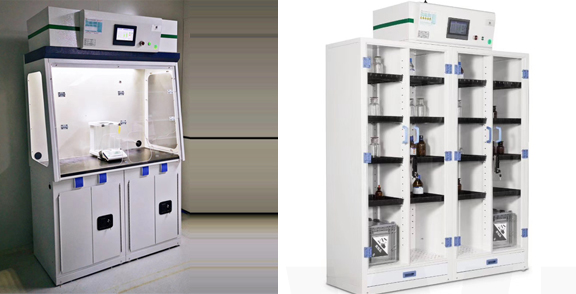
1. No complicated installation work is required (no need for external pipelines, fans, air supply systems, etc.). This cabinet is independent (with built-in fans) and can work simply by plugging in a power source;
2. Efficient and energy-saving (no need to consume any air conditioning, cold or warm air);
3. Environmental protection (not emitted into the atmosphere, not polluting the environment);
4. Adopting a turbine type silent fan (45dba);
5. Equipped with a movable roller cart;
6. The biggest feature is the use of molecular filters to adsorb toxic and volatile chemicals. Can fully protect laboratory personnel;
Control the spread of chemicals into the air from the source
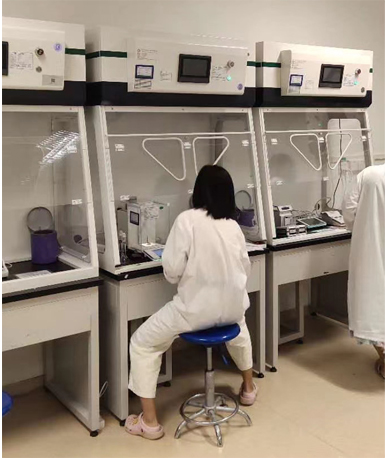
The clean air type fume hood can control the diffusion of chemical gases from the source. The chemical odors generated in the laboratory are evaporated and diffused into the air as chemical experiments occur. The clean air type fume hood can collect the volatile gas in the filtering device in the first time. The clean gas storage cabinet can store chemical reagents in an orderly and standardized manner in the laboratory, absorb toxic and harmful chemical gases evaporated from reagent bottles, and circulate the air inside the laboratory at a processing capacity of 90 cubic meters per hour, improving the air quality of the laboratory while protecting the safety and health of personnel.
Working principle of adsorption through molecular activated carbon filter
Composition and working principle of activated carbon
Activated carbon is a type of microcrystalline carbon material mainly made of carbon containing materials, with a black appearance, developed internal pore structure, large specific surface area, and strong adsorption capacity. There are a large number of invisible micropores in activated carbon materials. One gram of activated carbon material contains micropores, which can have a surface area of up to 800-3000 square meters when unfolded, and even higher for special purposes. That is to say, in a rice sized activated carbon particle, the internal surface area of micropores may be equivalent to the size of a living room. It is precisely these highly developed pore structures, like human capillaries, that endow activated carbon with excellent adsorption performance. Different filters with different treatment methods are equipped according to different needs, such as acidic volatilization reagents. If pure activated carbon is used, the filtration effect is very limited, and it needs to be treated with alkaline soaking or other additives to achieve the best filtration effect.
The interaction force between molecules is also called "van der Waals attraction". Although the speed of molecular motion is influenced by factors such as temperature and material, it always moves continuously in the microenvironment. Due to the mutual attraction force between molecules, when a molecule is captured by the pores of activated carbon and enters the pores of activated carbon, the mutual attraction between molecules will cause more molecules to be continuously attracted until the pores of activated carbon are filled.
The clean air type fume hood is equipped with 1-4 original imported fans. The air in the laboratory enters through the inclined front door opening. Various toxic and harmful gases and dust generated during experimental operations are adsorbed and filtered by high-efficiency molecular filters to form pure gas that is discharged outside the cabinet, thus achieving the purpose of purifying the air inside the cabinet and the indoor air, effectively protecting laboratory personnel from inhalation hazards caused by chemical operations.
Suitable for the following types of laboratory situations:
Suitable for liquid handling experiments
Suitable for experiments involving liquids and dust
Suitable for dust experiments
Placement of instruments in the laboratory
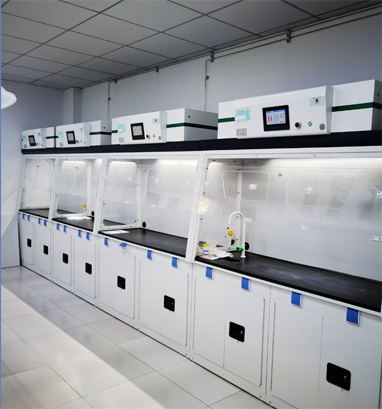
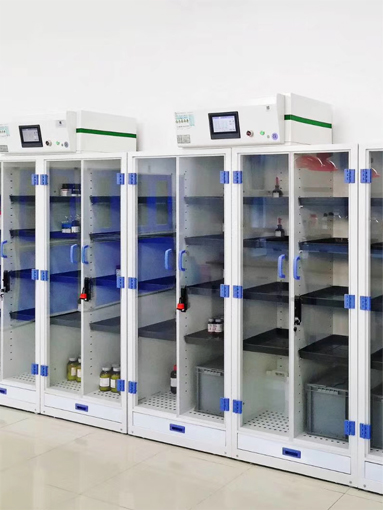
The clean air type fume hood is equipped with 1-4 original imported fans. The air in the laboratory enters through the inclined front door opening. Various toxic and harmful gases and dust generated during experimental operations are adsorbed and filtered by high-efficiency molecular filters to form pure gas that is discharged outside the cabinet, thus achieving the purpose of purifying the air inside the cabinet and the indoor air, effectively protecting laboratory personnel from inhalation hazards caused by chemical operations.
Suitable for the following types of laboratory situations:
Suitable for liquid handling experiments
Suitable for experiments involving liquids and dust
Suitable for dust experiments
Placement of instruments in the laboratory
Suitable for chemical experiments with small and medium doses, it is not suitable to use ductless fume hoods for handling large amounts of chemicals. Before purchasing, a questionnaire needs to be filled out to determine the chemical name, container type, opening or closing, concentration, temperature, operating dose, operating frequency, operating type, and minimum duration of the chemicals used for operation, in order to determine whether ductless fume hoods and activated carbon filters are suitable for use.
Contact:Leon Li
Tel:0514-87669016
Phone:15801711895
E-mail:leon@wuylab.com
Website:http://www.wuylab.com/
Address:Room 2310, Building 1, Guotai Building, Hanjiang District, Yangzhou City