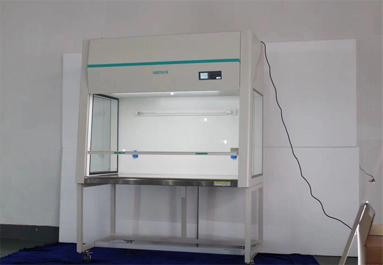
This is a new type of unidirectional flow clean workbench manufactured using advanced international technology, equipped with an adjustable air volume fan system; Equipped with sliding doors that can move up and down and be freely positioned; The touch switch adjusts the voltage to ensure that the wind speed in the working area is always in the ideal state.
It is widely used in industries such as healthcare, pharmaceuticals, biochemical experiments, electronics, precision instruments, and meters, and provides local purification workbenches in sterile and dust-free clean environments.
Provide an operating environment with a cleanliness level of 100, suitable for particle sizes of 0.5 μ m; M dust≤ 3.5 particles/liter
Horizontal or vertical laminar flow pattern
● Adopting ultra-thin non partition high-efficiency air filter, occupying small space
Adopting a touch sensitive electronic control panel, the fan air volume can be infinitely adjusted to ensure that the air speed in the working area is always in an ideal state
Stainless steel workbench, organic glass enclosure, can be equipped with UV lamp remote control electrical interface
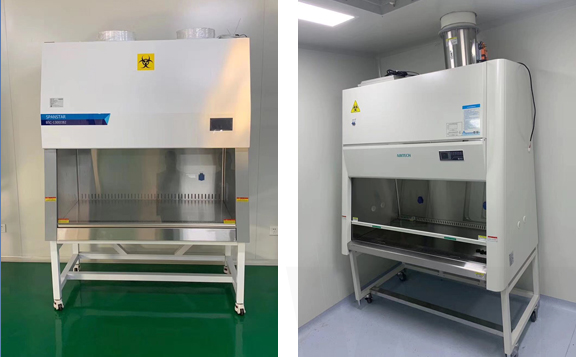
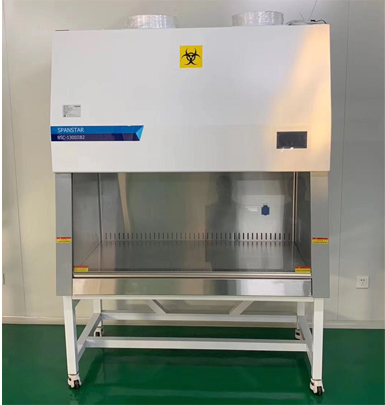
Biosafety cabinets can be divided into three categories: first level, second level, and third level to meet different requirements for biological research and epidemic prevention.
A first level biosafety cabinet can protect personnel and the environment without protecting samples. The principle of airflow is the same as that of a laboratory fume hood, with the difference being that the exhaust port is equipped with a HEPA filter. All types of biosafety cabinets use HEPA filters for exhaust and intake. The first level biosafety cabinet itself does not have a fan and relies on the fan in the external ventilation duct to drive the airflow. Due to the inability to provide protection for the test samples or products, it is currently rarely used.
The second level biosafety cabinet is currently the most widely used cabinet type. Like Class I biosafety cabinets, Class II biosafety cabinets also have airflow flowing into the front window opening, known as "inlet flow", to prevent aerosols that may be generated during microbial operations from escaping from the front window. Unlike Class I biosafety cabinets, unfiltered incoming airflow is captured by the air intake grille before reaching the work area, so the test sample will not be contaminated by external air. One unique feature of a Class II biosafety cabinet is that the vertical laminar airflow filtered by HEPA filters blows down from the top of the cabinet, known as the "sinking airflow". The sinking airflow continuously blows through the working area of the safety cabinet to protect the test samples in the cabinet from external dust or bacterial contamination.
According to the regulations of NSF49, secondary biosafety cabinets can be divided into four levels based on inlet airflow velocity, exhaust method, and circulation method: A1 type, A2 type (formerly B3 type), B1 type, and B2 type. All secondary biosafety cabinets can provide protection for staff, environment, and products.
The minimum or average measured airflow velocity of the front window of A1 type safety cabinet should be at least 0.38m/s. 70% of the gas is recycled to the work area through HEPA filters, and 30% of the gas is filtered out through exhaust ports. The minimum or average airflow velocity of the front window of A2 type safety cabinet should be at least 0.5m/s. 70% of the gas is recycled to the work area through HEPA filters, and 30% of the gas is filtered out through exhaust ports. The design of negative pressure surrounding the contaminated area of A2 type safety cabinet prevents the leakage of substances inside the cabinet.
The second level B-type biosafety cabinets are all safety cabinets connected to the exhaust system. The fan connected to the exhaust duct of the safety cabinet is connected to the emergency power supply to maintain negative pressure in the safety cabinet even in the event of a power outage, in order to prevent dangerous gas leaks such as in the laboratory. The minimum or average measured airflow velocity of the front window should be at least 0.5m/s (100fpm). 70% of the B1 type gas is discharged through the exhaust HEPA filter, and 30% of the gas is recycled to the work area through the supply HEPA filter. The B2 type is a 100% full row safety cabinet with no internal circulation airflow, which can provide both biological and chemical safety controls simultaneously.
Performance ratio of each cabinet type in the secondary biosafety cabinet
The third level biosafety cabinet is designed for the fourth level laboratory biosafety level and is currently the highest level of safety protection cabinet in the world. The cabinet is completely airtight, 100% fully discharged, and all gases do not participate in circulation. The staff operates through gloves connected to the cabinet, commonly known as Golve boxes. The test samples enter and exit the safety cabinet through a double door transfer box to ensure they are not contaminated, making it suitable for high-risk biological experiments.
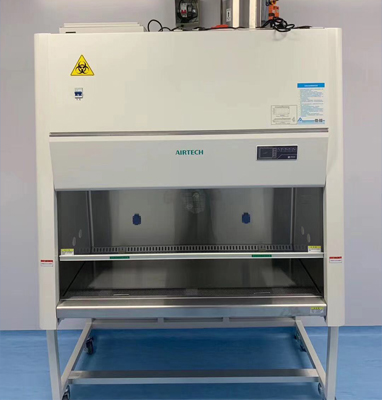
Under operating conditions that allow for the circulation of chemical gases, an A2 type secondary biosafety cabinet with an external exhaust pipe cover (Exhaust Collar) can be used. The difference between the exhaust pipe cover and a general hard pipe is that it has an air inlet that can suck in air; Connect the exhaust pipe cover to the external exhaust pipe and then connect it to an external exhaust fan. The air inlet on the exhaust pipe cover is crucial for maintaining the balance between the intake flow and the descending airflow of the A2 type secondary biosafety cabinet through the built-in fan. If a sealed external air duct is used, the intake flow will be too strong, which may lead to the effectiveness of the safety cabinet in protecting the product; The air inlet on the exhaust pipe cover can draw in air from indoors without affecting the airflow balance inside the safety cabinet. This condition only applies to trace amounts of toxic chemicals.
If the circulation of chemical gases is not allowed, a B2 type secondary biosafety cabinet equipped with hard pipes must be used. Due to the fact that the B-type safety cabinet is not an independent balancing system, its built-in fan can only produce sinking airflow, and the safety cabinet relies on external exhaust fans to produce intake airflow. This type of safety cabinet will be more complex to install and maintain, as the external exhaust fan must be balanced with the internal fan, otherwise it will result in the failure of the safety performance of the operator or product.
Contact:Leon Li
Tel:0514-87669016
Phone:15801711895
E-mail:leon@wuylab.com
Website:http://www.wuylab.com/
Address:Room 2310, Building 1, Guotai Building, Hanjiang District, Yangzhou City