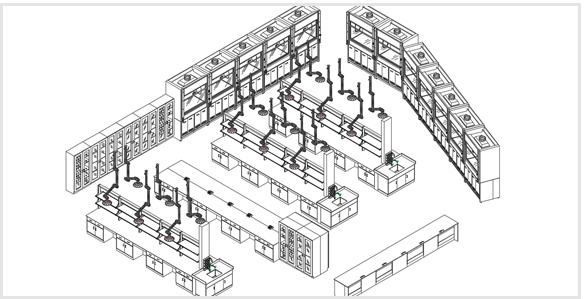
Laboratory design planning, fume hoods, experimental benches, ventilation systems, and supporting facilities are new, expanded, or renovated projects. It is not simply about selecting reasonable instruments and equipment, but also requires comprehensive consideration of the overall planning, reasonable layout, and graphic design of the laboratory, as well as basic infrastructure and conditions such as power supply, water supply, gas supply, ventilation, air purification, safety measures, and environmental protection.
(1) The experimental cabinet includes a central experimental platform, experimental platform, side platform, instrument platform, sky platform, drug cabinet, drug cabinet, glassware cabinet, etc.
(2) Air conditioning and ventilation facilities. In the new laboratory center, all building areas have air conditioning. The ventilation system includes fume hoods (toxic gas cabinets), exhaust hoods (fixed), movable exhaust hoods, exhaust fans, etc.
(3) Water facilities include laboratory pots, washing sinks, laboratory faucets, etc.
(4) Safety facilities include fire sprinkler systems, inert gas fire suppression systems, safety cabinets, emergency showers, eye washers, etc.
(5) Gas supply facilities include gas supply stations, gas supply panels, gas consumption panels, and their piping systems.
The laboratory of the 21st century is an intelligent laboratory that is safe, healthy, energy-saving, environmentally friendly, humanized, intelligent, and flexible. A new laboratory model is emerging that meets current experimental needs and can adapt to future development. It is driving the development of 21st century laboratories and is known as the "21st Century Laboratory" model, which has novel characteristics and is highly popular.
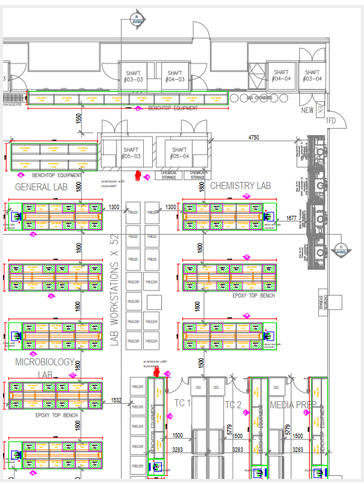
Maximizing flexibility has always been an important focus in designing or renovating an experimental building. Flexibility has multiple meanings, including ease of expansion, rapid adaptation to recombination and other changes, and the ability to accommodate multiple uses.
Maximizing flexibility means that laboratory equipment should not only have excellent functionality, but also have a high utilization rate for the reorganization of walls, supply systems, and workbenches in the event of major renovations or new constructions in the future, reducing waste of manpower and material resources.
1. Flexible supply system
A flexible raw material supply system is extremely important for most laboratory designs. The laboratory must be able to easily connect or disconnect on walls and ceilings to consider fast and low-cost equipment assembly. The supply system needs to meet initial requirements and adapt to expected future development plans.
2. Flexible indoor environment
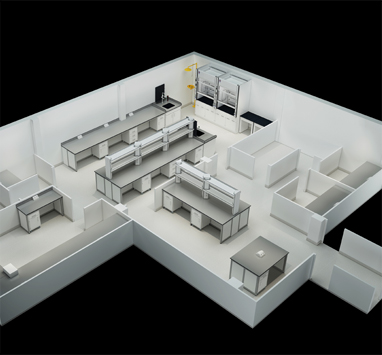
The laboratory is developing towards modularity. The laboratory workbench can be designed as movable, the service column can be adjusted and moved, and the laboratory space can be fully utilized. A movable partition wall can be designed for flexible partitioning. The docking station fixed on the wall or floor includes input ports for electricity, water, gas, and communication, with the characteristics of fast connection and disconnection, making it easy to combine and plug and play with the laboratory bench.
1. Social architecture suitable for team research
Humanized design is to make the most of the space in experimental buildings, providing opportunities for people to meet and flow together. Including lounges, conference rooms, atrium spaces, staircase spaces, shared laboratory equipment spaces, public service spaces, etc., to maximize opportunities for people to meet and communicate.
Pursuing spatial visual aesthetics, clean and bright appearance and color, safe and comfortable indoor environment, configuration that reflects the characteristics of the times, and meeting the health and comfort needs of staff.
Create flexible work systems and workstations, encourage research teams to change their space to meet their needs, design offices and writing areas as places for people to work in teams, design team based research centers, and create public spaces necessary for adjacent research team members to use reasonably.
2. Open laboratory mode
An open laboratory is a laboratory model that allows glass partitions almost anywhere. Glass walls make people feel less cramped and oppressed, allowing them to see each other while also having their own independent space.
Contact:Leon Li
Tel:0514-87669016
Phone:15801711895
E-mail:leon@wuylab.com
Website:http://www.wuylab.com/
Address:Room 2310, Building 1, Guotai Building, Hanjiang District, Yangzhou City